We’re soon going to publish our work on protest rights in the UK. We’ve done two studies: one a survey of activists and campaigners which shows how the context for protest has changed with recent legislative restrictions. The other is an experiment to see how best to talk about protest rights to persuade the general public. We’ll be publishing both in the coming weeks.
As part of the experiment, we asked a few questions about democracy and authoritarianism, since this was a good opportunity to get a read on the views of nearly 3500 people. We were following a hunch that perhaps when campaigners use these terms, the audiences they’re speaking to might not have a clear sense of what they actually mean — and that might risk unintended consequences. For example, the word ‘authoritarian’ is easily confused with the word ‘authoritative’ — and perhaps authoritative sounds quite appealing — most people like authoritative voices on subjects they care about.
We asked four questions, two free text where people could write what they want, and two where people chose an answer on a scale:
- Describe in a sentence or two what democracy is
- Describe in a sentence or two what authoritarianism is
- Thinking about how the UK is governed, how desirable or undesirable is a democratic system?
- Thinking about how the UK is governed, how desirable or undesirable is an authoritarian system?
Here’s how desirable / undesirable people find different systems of government:
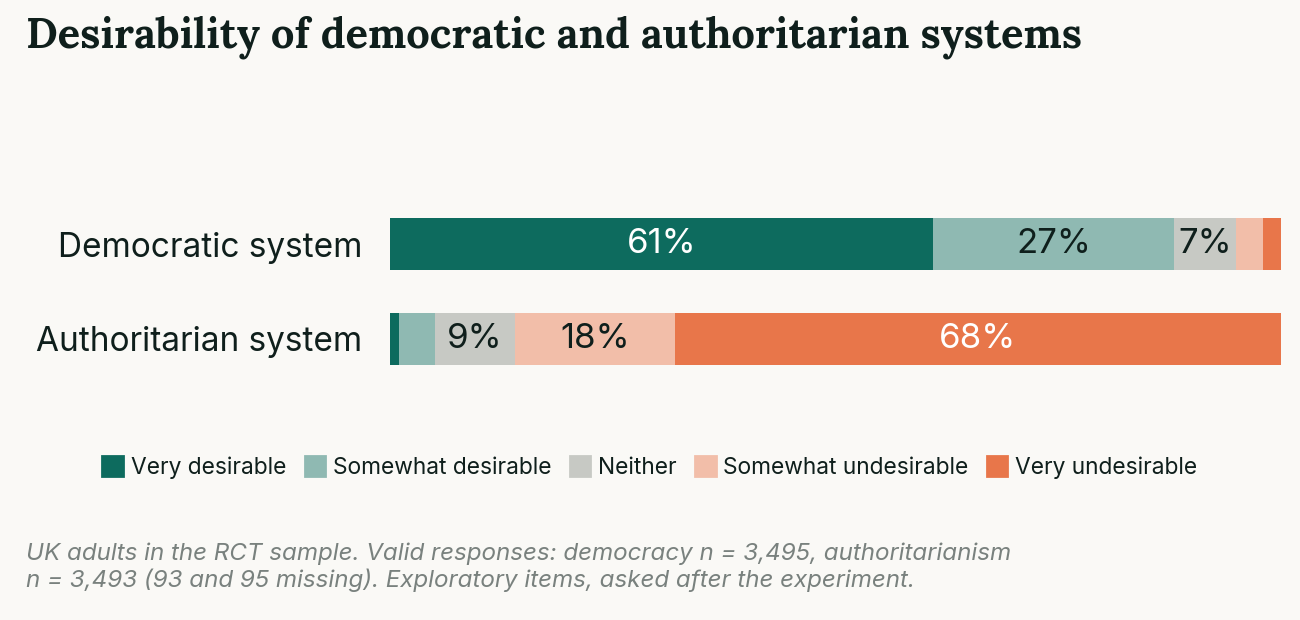
So 88% are pro-democracy and 86% are anti-authoritarian. Just 5% are pro-authoritarian and a similar percentage are anti-democracy.
This is heartening. Despite the amount of attention given to anti-democratic values on both left and right, these results suggest the vast majority of Britons hold straightforwardly pro-democracy and anti-authoritarian positions.
What did people say in the open questions about what these terms mean?
On democracy, most responses tracked closely with conventional definitions: 45% mention majority decision making and people having power, 44% mention elections or voting, 39% mention ‘having a say’, or words such as influence and participation. Very few people — just 0.3% — said they didn’t know or were really uncertain.
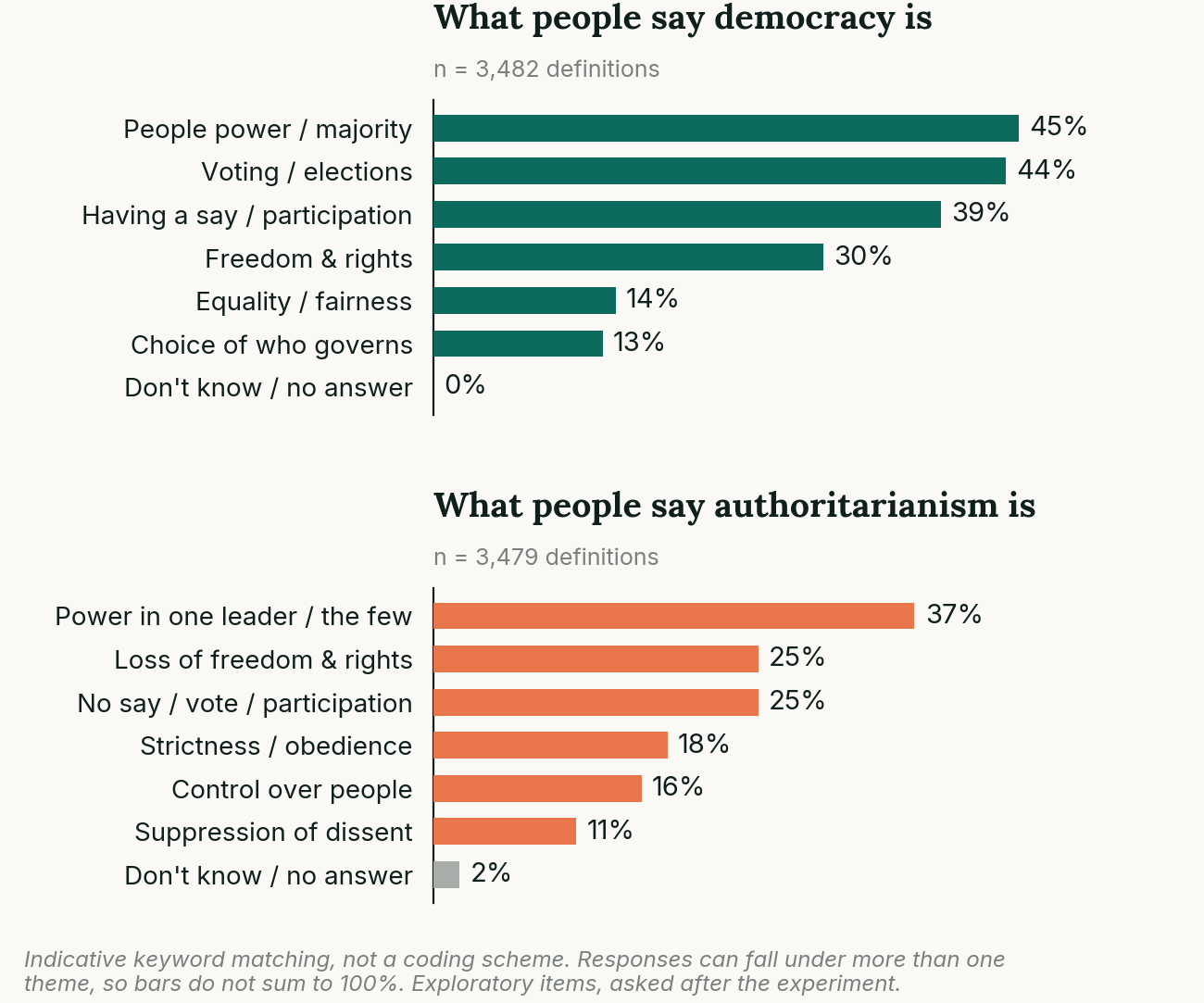
On authoritarianism, many themes were mirror images of the democratic ones: people mentioned power concentration in one/few leaders (37%), a loss of freedom or rights (25%), not having a say or participating (25%), as well as concepts such as strictness or having to obey rules (18%) and suppression of dissent (11%). There was also more confusion. 2.4% said they didn’t know or were uncertain what it meant — about 8 times as many as for democracy. But our hunch about the authoritarianism/authoritative confusion wasn’t really borne out; only about a dozen responses gave answers that said things like ‘It is authority, like the government, police etc’ or ‘Liking to be in charge’.
While we were broadly encouraged by these results, we wanted to understand more about the minority (175 people) who rated authoritarianism as ‘somewhat’ or ‘very’ desirable. What can we say about them? The first thing we wondered is whether they misunderstood authoritarianism. But a simple check showed that this group was as likely to correctly define it as those who oppose it. Next we wanted to see where these people sit on the political spectrum — and we could do this because earlier in the survey we’d asked people to put themselves on a left/right continuum.
It might be no great surprise to learn that the pro-authoritarian group tips strongly to the right.
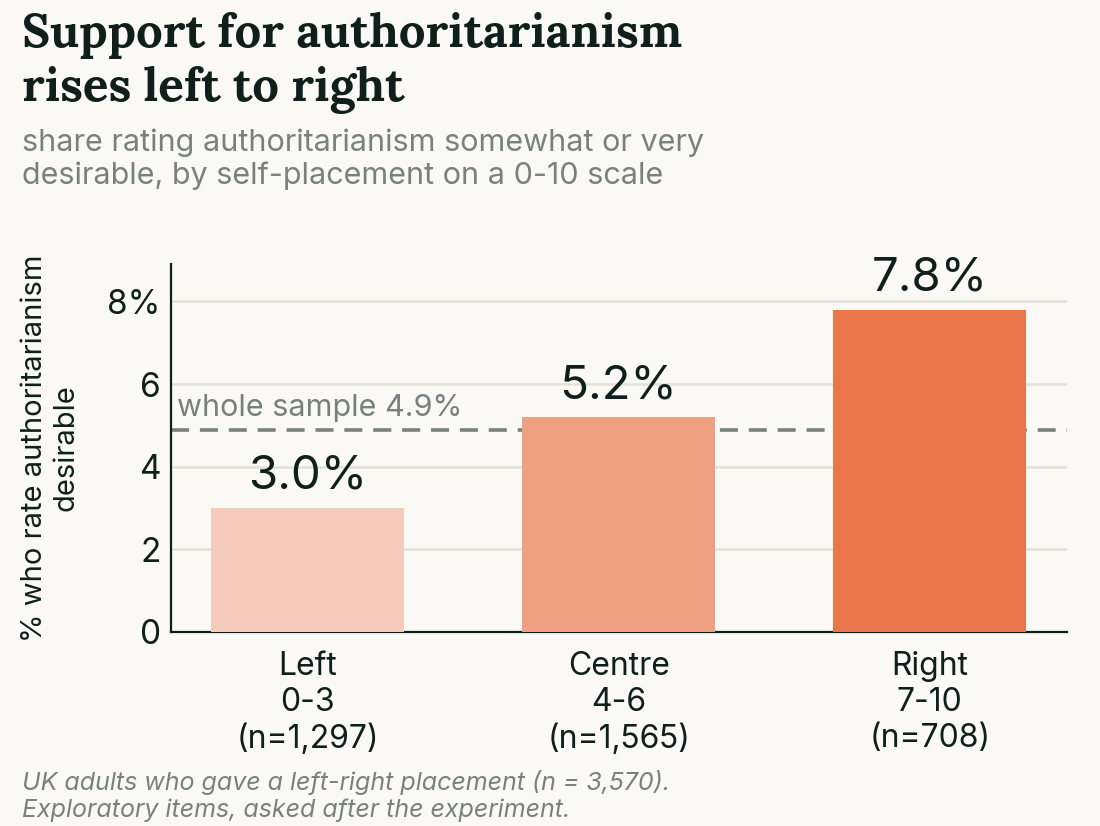
The pull to the right is concentrated at the extreme: among the small number who place themselves at the very far right (that is, 10 out of 10), nearly 20% find authoritarianism desirable.
Digging into this a little more, we charted people in terms of their voting intention (another question we asked in the survey). Support for authoritarianism comes from a very small minority across all political parties — a bit higher for Conservative and Reform voters than Green and Lib Dem, but not striking differences. You can see this in the brown bars in the chart below.
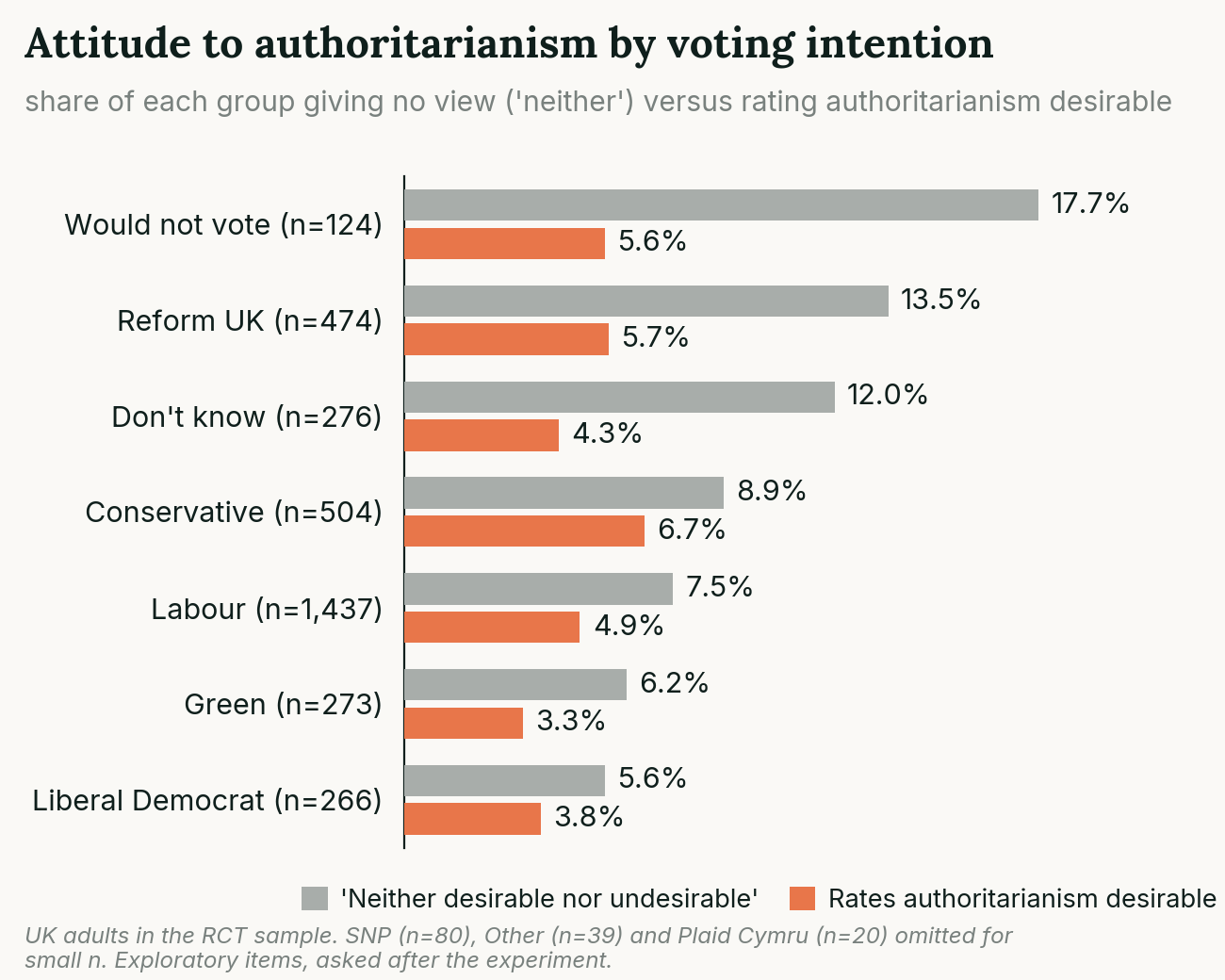
The second thing this chart shows is something quite different. The grey bars are the percentages by party who find authoritarianism ‘neither desirable nor undesirable’. What varies most between groups is not support for authoritarianism, but having no view, or perhaps being indifferent. This is a pattern of disengagement: the highest numbers here are for those who would not vote, those who don’t know how they would vote, and Reform voters. Right/left differences are very small.
So our hunch that people might misunderstand authoritarianism wasn’t right. Instead, what this shows is that, for the least politically engaged, the term just doesn’t really hold any meaning at all. It’s ‘meh’.
For campaigners, what this all means is that firstly, you are pushing an open door on the general principle of democracy: the overwhelming majority are already pro-democracy and anti-authoritarian, so you don’t need to win that argument. And this holds across most of the political spectrum: genuine enthusiasm for authoritarianism comes from a very small minority. Secondly, abstract terms like ‘authoritarianism’ (and probably ‘democratic backsliding’, ‘democratic rights’ and other similar concepts) barely register with the people who are least engaged; concrete language about specific freedoms and specific harms is probably a better bet. Brits are pro-democracy. The risk is that the language used to defend it doesn’t connect with the people who are hardest to reach.