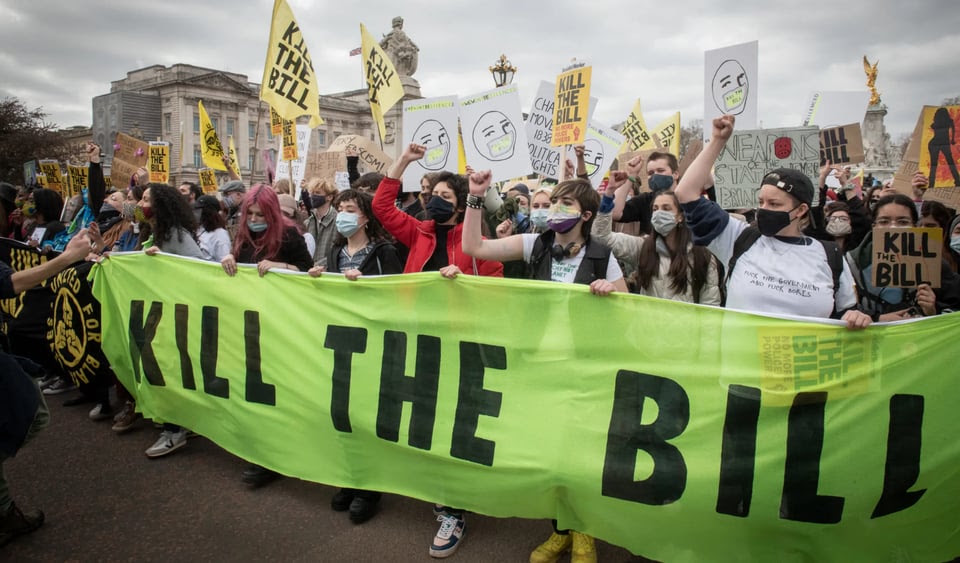
Over the past few years the legal environment for protest in England and Wales has been radically reshaped. We have seen the Police, Crime, Sentencing and Courts Act 2022, the Public Order Act 2023 and the National Security Act 2023, and more recently changes to the use of terrorism powers following the proscription of Palestine Action. NGOs, campaigners and others have been shocked by the changes - as have even parts of the government. Scrutinising the Public Order Bill, parliament’s own Joint Committee on Human Rights warned it risked a “chilling effect on the right to protest”. The UN said much the same. There is real concern about silencing protest. But a competing body of research - which academics call the ‘repression paradox’ - suggests the opposite: that legislation which unjustly clamps down on peaceful protest can backfire, swelling the numbers rather than shrinking them.
To find out what has happened in the UK, we teamed up with Fossil Free London to survey 415 UK campaigners and activists earlier this year.
Read our findings below, or join our webinar on Thursday 15 October (17:00-18:00 BST), where we’ll share insights from this and other new research. Register on Eventbrite
Overall participation is up, not down
Our headline finding doesn’t support a simple chilling narrative. Asked how their protest attendance compares with five years ago, 48% of respondents said they’re protesting more against 34% who said they’re protesting less.
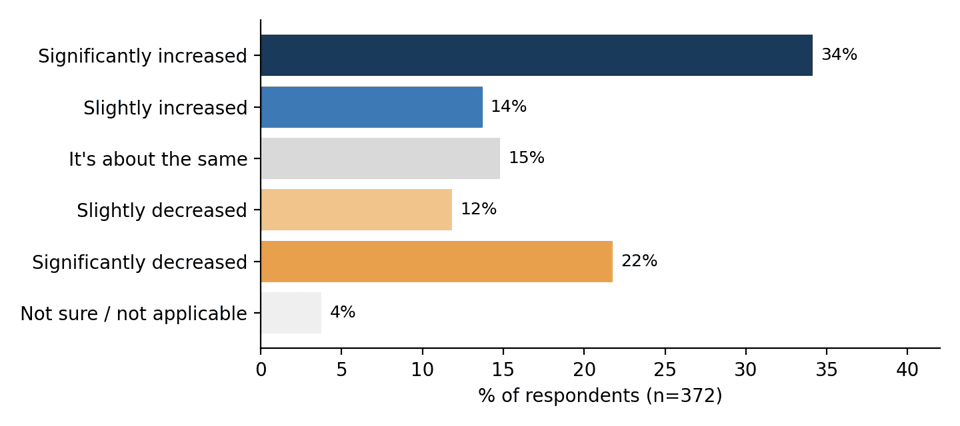
Nearly two-thirds (64%) agreed that stronger anti-protest laws make them more determined. Growth is driven overwhelmingly by Gaza - half of the people who said why they were protesting more mentioned Palestine; counter-mobilisation against the far right and the fact that retirement has freed up more time were other common reasons. A small group, around one in eleven, said the crackdown itself was their reason for turning out more. “I wanted to protest the proscription of Palestine Action,” as one respondent put it.
While stricter protest laws don’t appear to be deterring people across the board, these headline figures hide a more complex story.
Older people are driving the increase
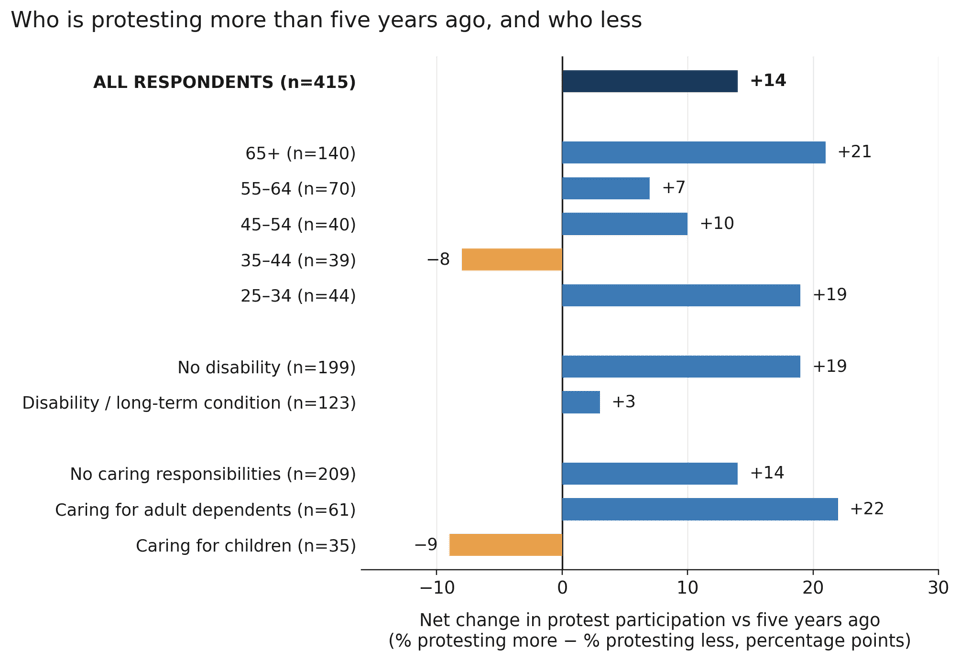
Over-65s are the engine of growth. All groups over the age of 45 reported increasing their protest attendance in the last five years. The 35-44 group - an age when busy careers and young children often coincide - is the only age group in net decline. People caring for children are down while people caring for adult dependents (who are typically older) are up. Many social movements are being carried by people who are mostly past their working years.
There’s a lot of fear, especially for the young
Our respondents take a dismal view of the environment we are in. 97% agree the right to protest has been significantly restricted, 85% ‘strongly’. 93% worry that peaceful campaigning could be labelled as extremism or terrorism. 82% reject the idea that police use their powers fairly and proportionately and 42% described policing at the last protest they attended as aggressive or confrontational.
Asked what actually affects their willingness to turn up, the top three answers are all about fear.
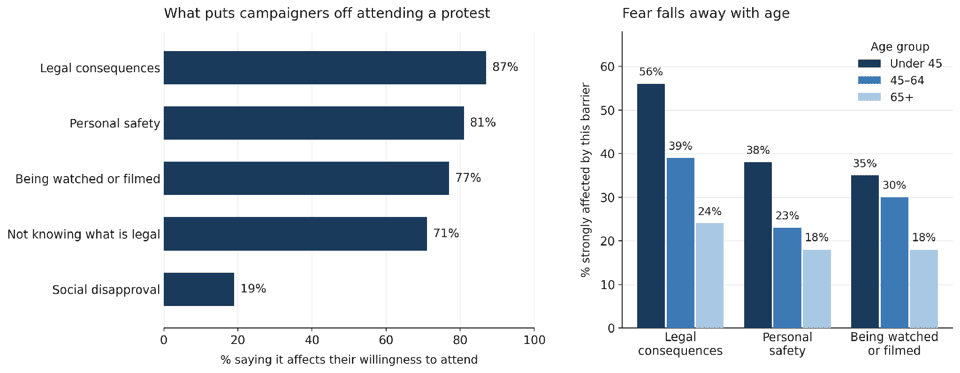
The figure on the right shows how these fears fall unevenly. Fear of legal consequences strongly affects 56% of under-45s but only 24% of over-65s. Risk of losing work affects 67% of under-45s and 13% of the over-65s. The people most willing to be arrested are, broadly, the people with the least to lose - those without employers, careers and dependent children. That’s a fragile base for a movement to be built on, and several respondents said so themselves. One said, “I feel very protective of young people and children I see - whereas I used to feel joy to see new generations protest, now I have fear for them.”
The chilling is selective
Many people told us how they were changing the way they spoke up against issues they care about. 37% have shifted from protests towards petitions, boycotts, donations and lobbying because of their concerns about protest. They said they had dropped direct action and arrestable tactics, and avoided open support for Palestine Action specifically.
95 of the respondents said they had protested in the past but not in the last year - we consider these to be the people most likely to have been deterred. Amongst them, 64% say that, while they support the right to protest, they do not feel able or motivated to act. Only 38% of this group (compared to 64% overall) say tougher laws make them more determined and they are twice as likely as those still protesting to have switched to other, safer actions. The behaviour of this group is more illustrative of what a chilled population looks like.
A major barrier to protesting is that people no longer know what is legal. Half of our sample - experienced campaigners, many of them veterans of decades - are not confident of their rights at a protest, and 89% say recent laws have made legality unclear. This is another way that chilling operates - through a general, unspecific sense that the rules are no longer clear.
What this means for organisers
Treat legal uncertainty as an organising problem, not a legal one. Not knowing what is legal deters 71% of this sample. Groups like Green and Black Cross, Netpol, Liberty and CASP (Climate Action Support Pathway) already run know-your-rights training; funders could usefully make more of it possible, alongside pre-action legal Q&As and visible legal observers - particularly for younger protesters, who are both the most fearful and the least confident of their rights.
Build roles across the risk spectrum. People who get chilled do not vanish and they still care - they sign petitions and email their MPs. Groups that offer meaningful lower-risk roles - court support, logistics, outreach, digital, fundraising - and treat the people doing them as full participants might hold on to those who are fearful of taking on more visible involvement.
Do not assume the young will carry the risk. The evidence here points the other way. Any strategy that depends on a supply of arrestable twenty-somethings should be stress-tested against the fact that under-45s report the most acute fear of arrest, surveillance and violence, and the least confidence about what the law allows.
Fight feelings of futility as much as fear. Belief that protest works was the weakest motivation we measured - 59% named it as a motivating factor, compared with 93% for strength of feeling, and 89% a moral duty. Fear and futility compound each other - and several respondents described being caught between tactics they think are safe but ineffective, and tactics they think work but which now carry too much jeopardy. Communicating concrete wins can act as a counter to the chilling effect.
Overall, the evidence suggests that recent protest legislation has produced a selective chilling effect. It has not stopped protest altogether, but it has narrowed the tactics people are willing to use, increased caution around particular causes, and deterred some groups more than others. At the same time, repression has mobilised many campaigners, leaving overall participation resilient even as higher-risk activism has become more constrained.
Read the full report: How UK campaigners are responding to tougher protest restrictions (Rogers, Ostarek, Wells & Nadel, 2026), funded by the Joseph Rowntree Reform Trust.
Join our upcoming webinar to learn more: 15 October, 17:00-18:00 (BST). Register on Eventbrite
Social Change Lab