At Social Change Lab, we’re not ones to shy away from big, challenging questions. A key question for us - and many others - is what are the ingredients that make a protest movement successful? We spent the last six months researching this question and we’re excited to share what we’ve learned.
Our research included a literature review, interviews with academics and social movement experts, public opinion polling, a case study and interviews with policymakers. Bringing all the evidence together, and focusing on the recurring themes, we identified the key success factors of protest and protest movements.
We think identifying success factors could be an important way for social movements, particularly those utilising protest as a tactic, to set themselves up for success. For example, we think our findings could be helpful to a variety of important issues, such as climate change, animal advocacy, pro-democracy, anti-racism and other progressive issues. It could also be useful for funders to identify which groups are following evidence-based principles of how to be effective as a social movement organisation (SMO), in order to support these groups more.
In this blog post, we’ll talk about our most important findings. For more information, you can see our full report. We hope this information is helpful to advocates working on a range of progressive causes, and we welcome any feedback.
Summary Table
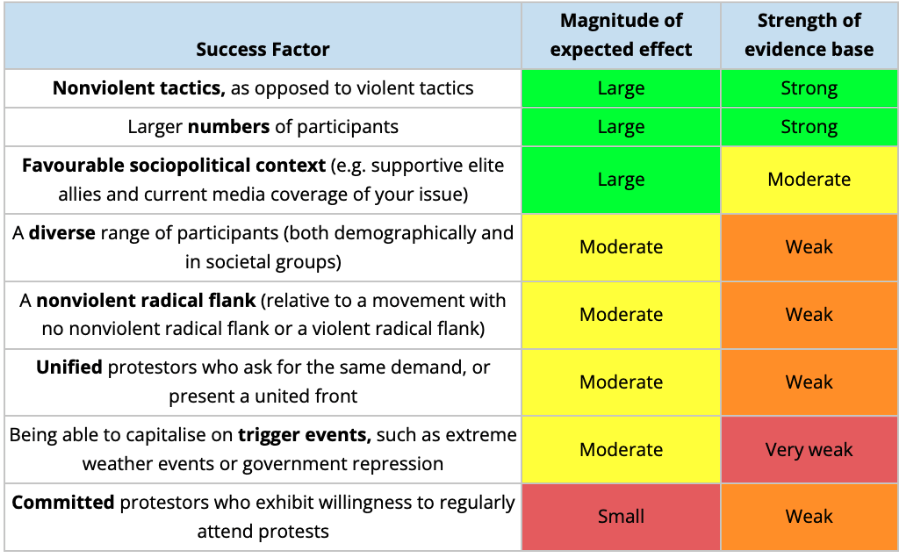
Below, we scored success factors on two different scales, one to rate the causal importance of each success factor to achieving desired outcomes, and the other to rate the strength of evidence for that claim. In both cases, the ratings are relative rather than absolute. The evidence for each success factor can be seen in greater detail in the full report, or our literature review.
Table 1: Our current estimates, and strength of evidence for the relative causal importance of different success factors.
What are the most important success factors?
There are three particular success factors that stand out as seeming to have large effects on movement chance’s of success, as well as having a strong body of evidence behind them. These three factors, in no particular order, are:
Nonviolent tactics
Favourable sociopolitical context
Large numbers of participants.
We’ll expand on each of these and show some of the key bits of evidence for them.
1. Nonviolent tactics, as opposed to violent tactics
It is hotly debated within social movement circles whether activists should move towards using more violent tactics because the problems we face are so severe and progress seems so slow. However, our research, and the available evidence, suggests that nonviolent tactics are more likely to lead to successful outcomes relative to violent outcomes.
Some of the evidence we base this conclusion on are:
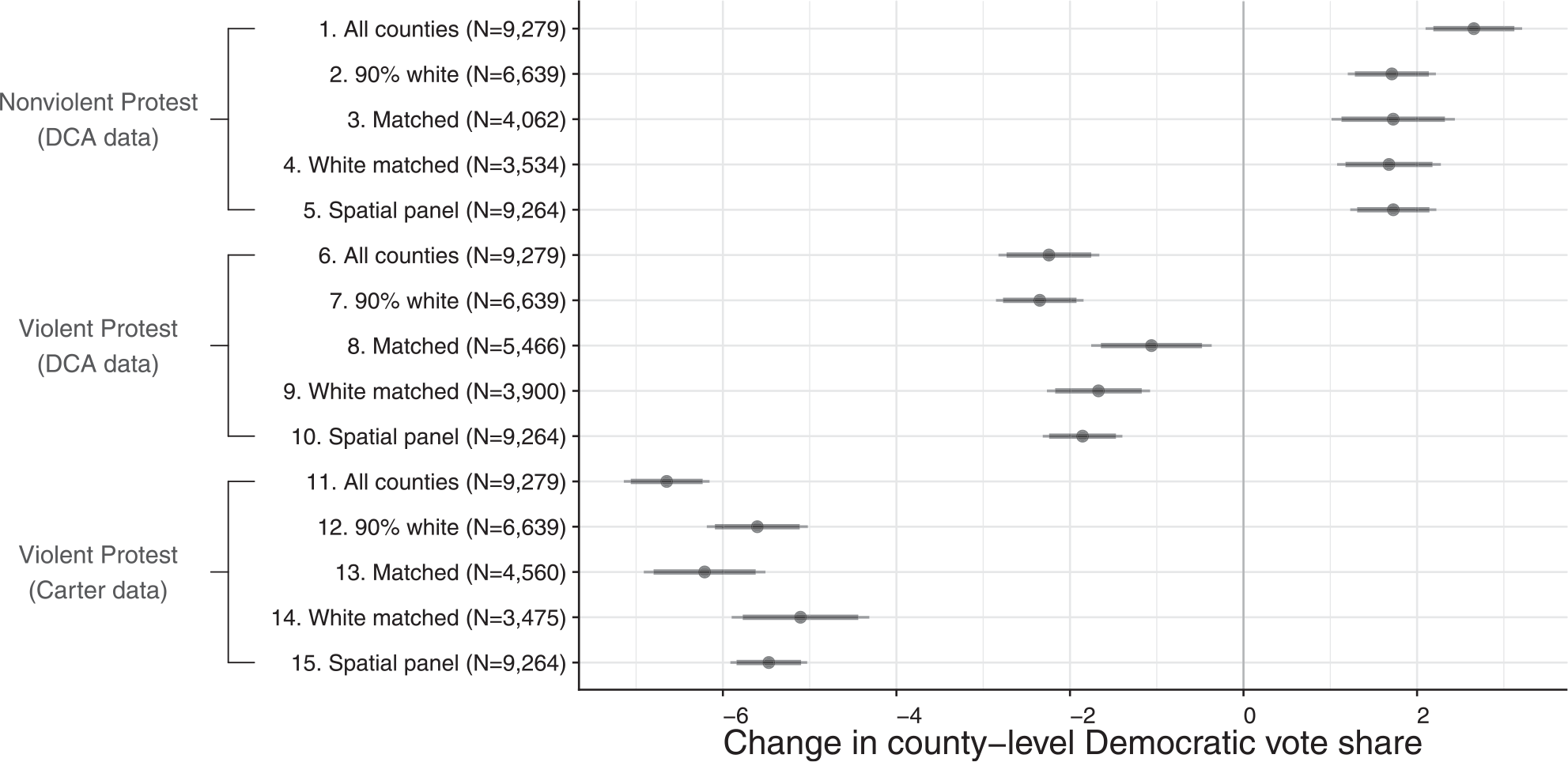
Wasow (2020), studying Civil Rights protests in the US from the 1960s, found that states with nonviolent protest tended, in line with their aims, to have higher votes for Democratic candidates. States with more violent protest, by contrast, saw increased votes for Republican candidates.
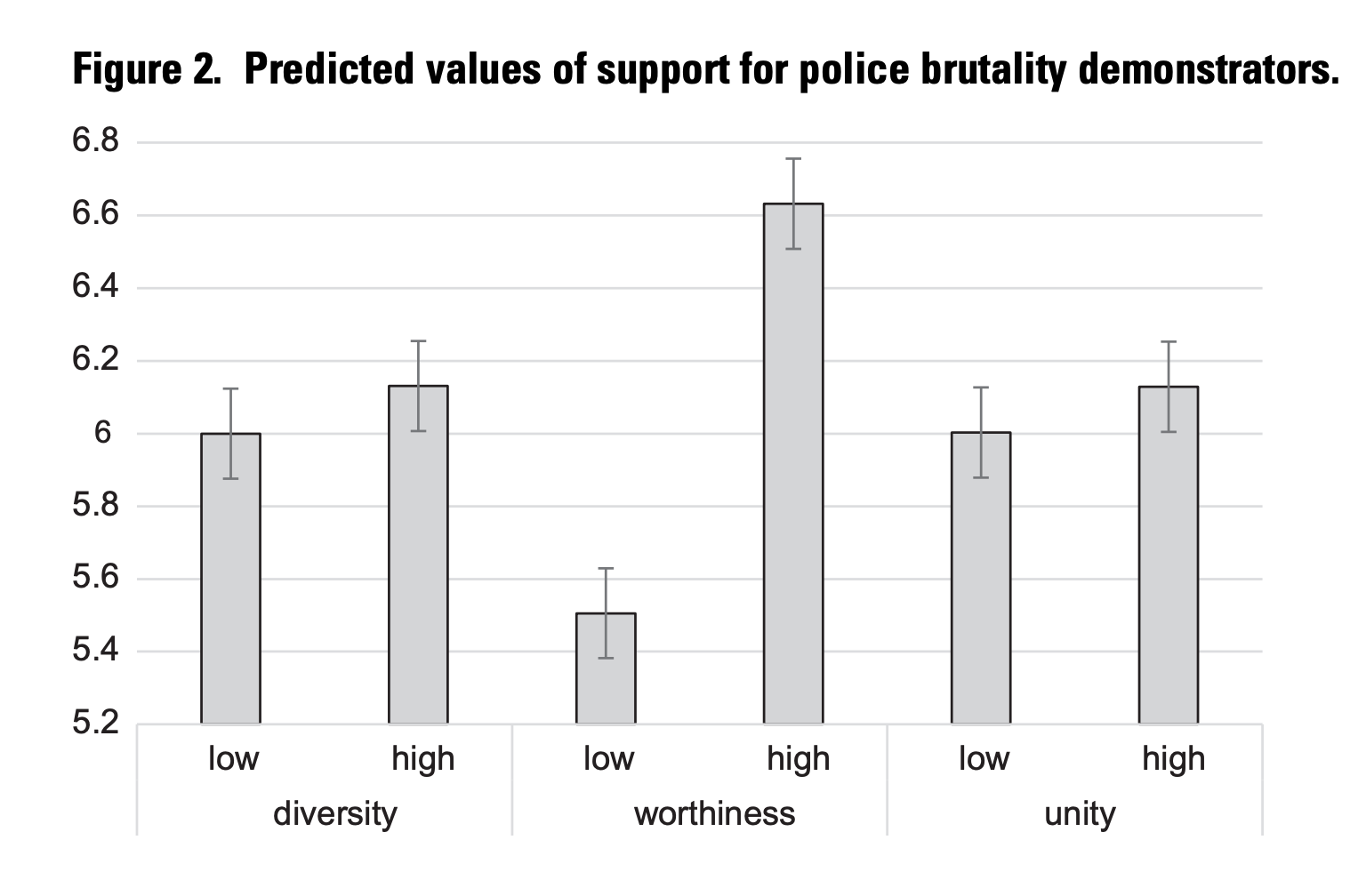
Other experiments have shown that the support both from the public and elected representatives is higher if protests are nonviolent. The graph below, from Wouters (2019) shows the difference in public support (with ‘worthiness’ as their proxy for nonviolence). The experiment with policymakers, Wouters and Walgrave (2017), also finds that more nonviolent protests are much more likely to persuade elected representatives to hold views closer to that of the protestors.
The question of whether violence or nonviolence is more effective is the most studied by academics amongst the factors we examined. Most studies reach similar conclusions (but obviously context matters and there are some exceptions), providing weight to this conclusion.
Our interviews with experts corroborated the research literature. Here are some of the things they said:
“We can say with a reasonable amount of confidence that violence is probably less effective than nonviolence”
“There are lots of similarities across nations about the ineffectiveness of violent protest, this is true whether you’re in an autocratic or democratic context, except in the US where it might be more socially acceptable.”
“Lots of advocates of violent protest argue for the ‘radical flank effect’, but it seems really obvious that sometimes the radical flank effect will work and other times it won’t, you can’t just cite the radical flank effect as a justification for violent protests.”
2. Favourable sociopolitical context
This one might seem obvious, but we hadn’t seen too much discussion of this outside academic circles, so we think it’s worth reiterating. Our research showed that factors largely outside the SMO’s control - things like pre-existing public opinion, supportive elites, media environment, and luck - play a big part in determining the success of a protest movement. We haven’t reviewed the literature on this extensively (as it was slightly outside the scope of our report) but based on what we did find, we think it’s an important consideration.
Some of the relevant evidence from our literature review includes:
Giugni (2007) talks about the impact of elite allies, claiming that social movement success requires both public opinion being on side and for the protesters to have political allies. He found that this combination of protest, public opinion, and political allies was important for increasing spending on environmental protection and reducing spending on nuclear energy (in line with the demands of the social movement).
Bernardi et al. (2020) finds that legislator attention will only occur if there is a strong protestor signal (e.g. large protests) AND this signal is supported by existing public priorities (e.g. high levels of supportive public opinion).
Some things our experts said about this:
“Elite allies seem to be immensely important, because legislators are ultimately the people who drive the changes. The reception that protest receives from elites may account for 80% of the variance in outcomes.”
“One thing worth mentioning is that the right conditions need to exist for a mass protest movement to emerge.”
“You also can’t downplay the impact of luck in social movement success”
3. Larger numbers of participants.
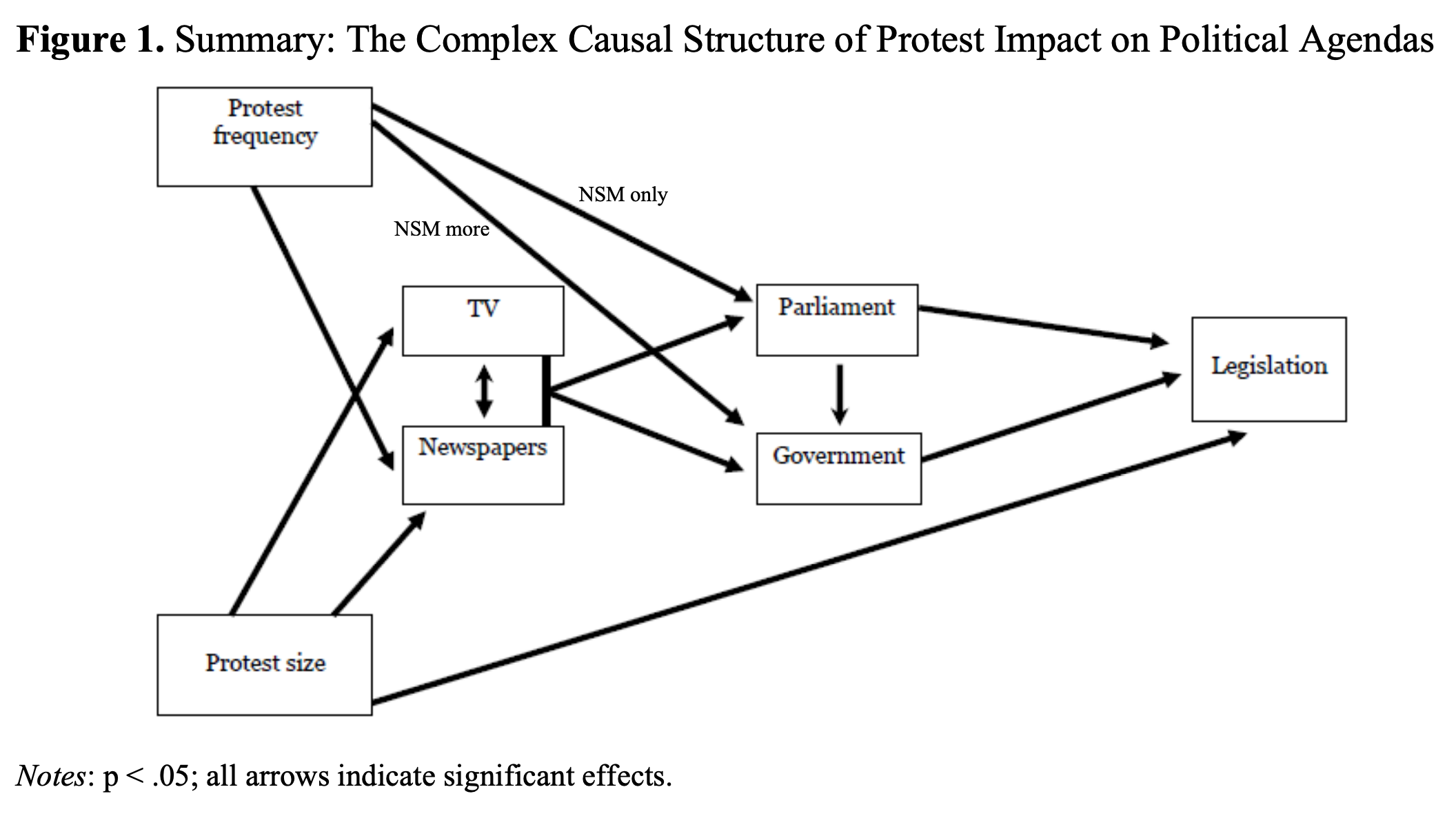
In line with Erica Chenoweth’s famous 3.5% rule, the size of a protest movement seems to be an extremely important consideration for achieving protest goals. The causal chain is slightly harder to untangle here, since it’s not always clear if a protest is more likely to succeed because it’s larger, or if it’s larger because people think it’s more likely to succeed (and therefore feel more comfortable about joining it). Some recent experimental evidence suggests that protest size does have a causal impact on outcomes, in that larger protests can lead to higher chances of winning a policy change.
Relevant evidence from our literature review:
Wouters and Walgrave (2017) find that elected officials are much more likely to hold a position closer to the protestors if a protest is larger, and that they are more likely to take action (e.g. propose a bill or ask a question).
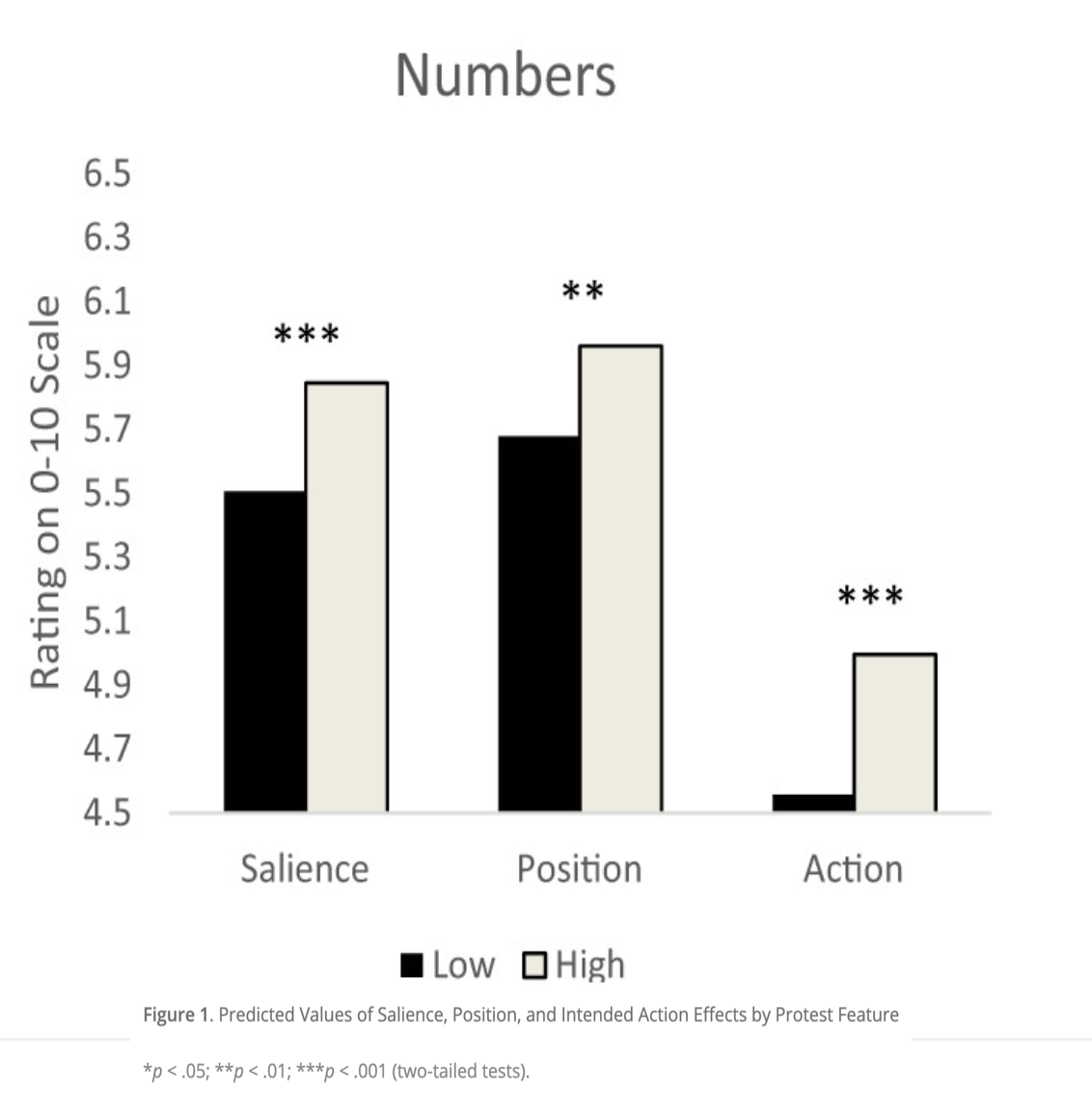
Teeselink and Melios (2021) looked at the effects of theBlack Lives Matter protests in 2020. Their quasi-experiment showed that people in areas with Black Lives Matter protests with high numbers participating were more likely to vote Democrat than those in areas with protests with low participation, showing the importance of numbers on political outcomes.
Walgrave and Vliegenthart (2012) studied protests between 1993 and 2000 in Belgium and also found a significant impact of protest size on legislation. The larger the number of protesters, the more likely it was that legislation was affected.
Quotes from our expert interviews regarding numbers:
“The number of people at a protest is probably the most important factor in its success, but this is somewhat obvious to protestors.”
“Although politicians invest so much effort in discovering public opinion, often they don’t have good models, so they might use protest and the numbers at a protest to get a sense of public opinion.”
“It’s worth noting that it’s very unclear what effect small protests are likely to have - some studies looking at small protests against austerity in Greece, Spain, and Portugal seem to find that they had pretty much zero effect.
Limitations of our work
Three quick caveats when reading this research:
This report is not so much an exhaustive handbook of what protest-focused movements should do to be successful, as a summary of the current available evidence. Some factors are easier to measure relative to others, so there might be a bias in this report for factors that are more measurable.
Movements and SMOs are optimising for different outcomes, such as changing public opinion, influencing policy, altering public discourse, etc. This means it’s not possible to do a like-for-like comparison for different tactics or strategies, as they often focus on different outcomes.
Our report covers high-level movement strategy, such as decisions about how much effort movement leaders should put into size, diversity, and internal governance. We don’t cover more on-the-ground guidance on how to run effective campaigns, as we think this is covered fairly well in other work. For those interested in the nuts and bolts of how to campaign effectively, we suggest the following resources: Activist Handbook, The Commons, Campaign Bootcamp and Effective Activist.
Conclusion
Overall, we think our top three findings aren’t particularly groundbreaking, but support what other movement strategists have been saying previously. It highlights the importance of nonviolent discipline amongst social movement organisations, especially amidst calls for more violent actions within particular movements. It also supports the idea that numbers matter a lot - no surprise to activists who believe in people power.
However, our more surprising finding of the importance of timing, external factors and luck leaves some open questions. It’s been discussed previously that social movements may ebb and flow in cycles, but it’s not clear what grassroots organisations should be doing in their fallow periods. This is an area we think could be explored further.
We hope that the full success factors report and this blog post sets out some tangible and actionable ways in which movement leaders, advocates and funders can ensure we optimise work on some of the most challenging issues of our time. Any feedback, comments or suggestions, feel free to reach out to us via email.