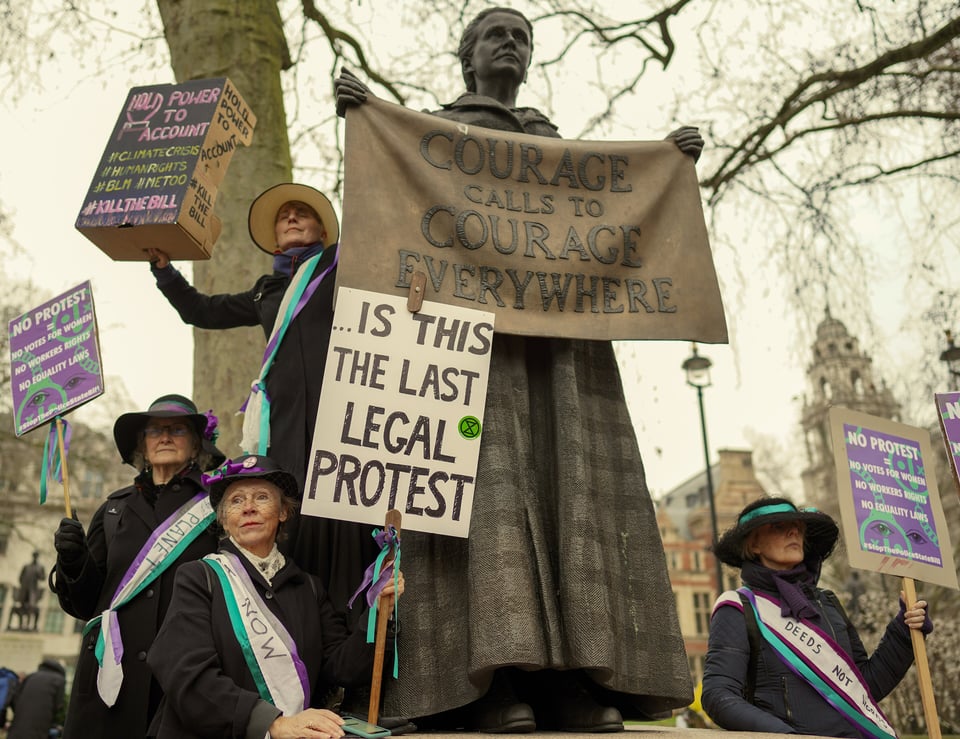
Since 2022, three Acts of Parliament have widened police powers over protest in England and Wales, and activists have faced much longer prison sentences for non-violent protest. Even though most people back protest in principle, there has been little public pushback. In a 2024 Demos poll, 83% of the UK public agreed that everyone should be able to protest on issues they care about. But 73% think protests rarely, if ever, make a difference, and most people have never participated in one. Support for protest is wide but very passive, which makes it a key task for campaigners to turn that dormant support into action.
To find out which messages can do this best, we ran a pre-registered randomised controlled trial with nearly 3,500 UK adults. Each participant read one short text of around 120 words using one of five protest rights framings, or an unrelated control text (on how postcodes work, for example). We then measured people’s attitudes to protest rights, how willing they were to act to protect them, and whether they clicked through to a real petition or a tool for writing to their MP. The five framings were:
- Defensive rights framing: protest as a basic right under threat, highlighting the criminalisation of peaceful protest. This is the framing advocates use most today.
- Injustice framing: similar to defensive rights framing but with a stronger injustice angle; recent enforcement as disproportionate or unfair, for example long prison sentences for non-violent protest.
- Efficacy/Protest as a tool framing: protest as a tool that works, backed by concrete wins such as a hospital A&E saved from closure.
- Corporate power framing: companies using court orders to shut down protest, and new laws protecting company sites, in a system that favours those with power.
- Universal threat framing: powers written for one kind of protest can be turned on any cause, including your own.
Showing that protest works made people most willing to act
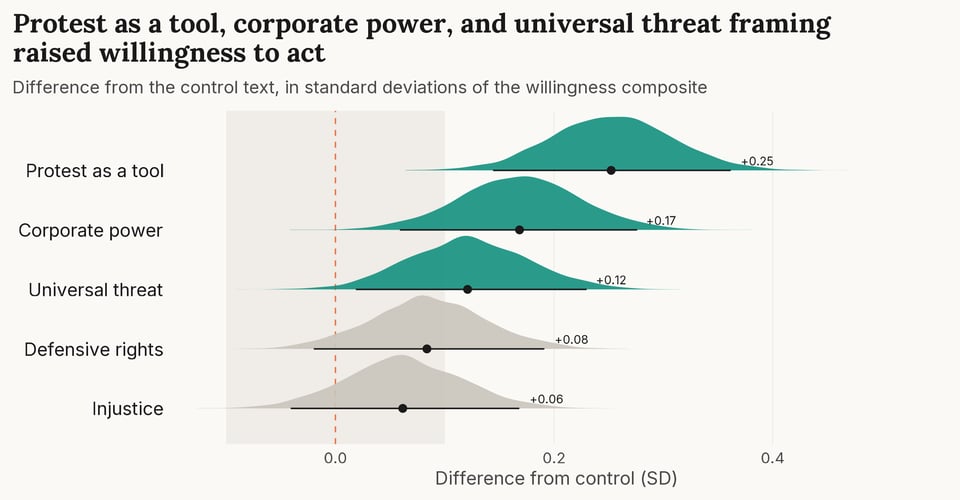
We asked people how willing they are, in the next few months, to share information on social media, contact their MP, or donate to or join an organisation defending protest rights. Protest as a tool, corporate power and universal threat framing raised willingness to act compared with the control text. Protest as a tool framing had the largest effect. It outperformed every other framing except corporate power.
The defensive rights and injustice framings did no better than the control. This matters because defensive rights is the framing the sector currently leans on most. Slogans like “Protest is not a crime”, images of arrests and the language of rights being eroded dominate communication on this issue (see the NEON messaging guide).
Protest as a tool framing worked by convincing people that protest can make a difference
Framing protest as a tool successfully increased people’s belief that protest can make a difference, and it did so on all three of our measures: how much of a difference protests make to the issues they are about, whether people acting together could help protect the right to protest, and whether the government changes course when enough people speak up. It also made people more hopeful, and made them feel the new laws were more likely to affect someone like them personally. A mediation analysis indicated that this is why protest as a tool framing affected people’s willingness to act in defence of protest rights so much.
Only protest as a tool framing changed what people did
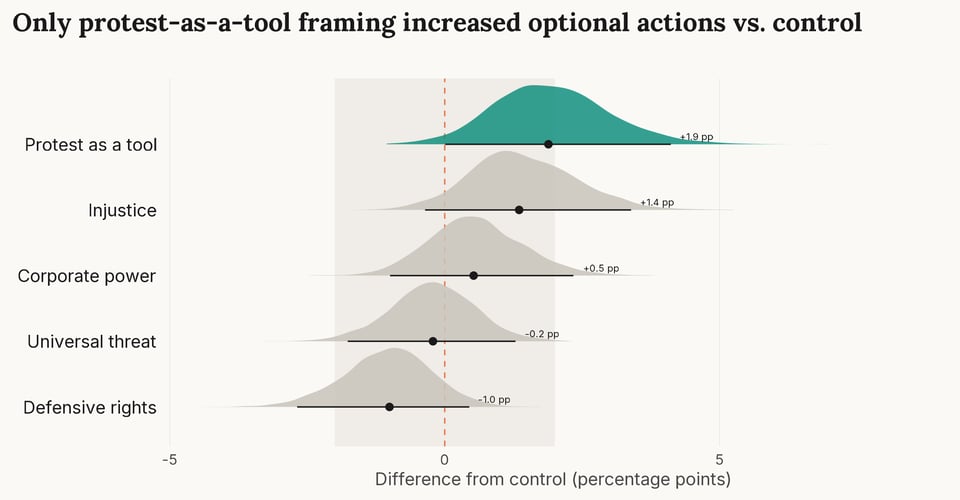
Saying you are willing to act is one thing, actually doing something is another. So towards the end of the survey we offered everyone two optional links: a real petition asking the UK’s Chief Prosecutors to drop charges against peaceful protesters, and a tool for writing to their MP about protest rights. People who had read a protest as a tool text were about 2 percentage points more likely to click through than people who had read the control text. No other framing credibly differed from the control.
Defensive rights framing again came out worst and was associated with clearly lower click rates than protest as a tool framing (about 3 percentage points).
What this means for campaigners
Our results give fairly clear guidance, and it is closely in line with the recommendations in NEON’s recent messaging guide on protest.
Some recommendations for campaigners:
Lead with wins. The most useful thing campaigners can do to turn public support into action is to show that protest works. That means leading with concrete, preferably local, examples of ordinary people winning through protest, and connecting them to how the new laws put that at risk.
Don’t rely solely on rights-based language. Leading with the erosion of rights or the criminalisation of protest did least to move people to act. There may be ways that campaigners can still talk about rights, but showing what protest achieves appears to be the best way to make the right to protest feel real and worth defending. We speculate that a reason why defensive rights framing did so poorly is that “Protest is not a crime” messages put protest and crime in the same sentence, which may strengthen the link between the two in people’s minds, in the same way that telling someone “don’t think of an elephant” brings an elephant to mind.
One message can work across audiences. The framings worked similarly whatever people’s politics, so campaigners probably do not need separate scripts for left- and right-leaning audiences.
Watch the recording of our webinar, where we presented these findings alongside our recent campaigner survey.
The full report includes additional results, the complete methods, a more in-depth discussion of the findings, and example texts for every framing.
This research was funded by the Joseph Rowntree Reform Trust as part of a research programme with Fossil Free London, which also included a survey of 415 campaigners. The views expressed are those of the authors and not necessarily those of the Trust.
Markus Ostarek
Director of Research & Data, Social Change Lab